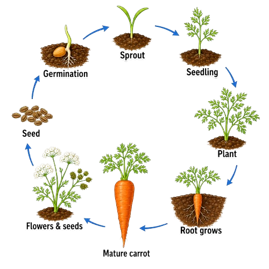
How carrots grow
The Secret Carrot’s Big Journey
The Feathery Sprout
Once the tiny seed awakens underground, a delicate, light green shoot pushes bravely up through the soil. It unfurls its very first leaves, which look like soft, tiny green feathers dancing in the warm air (Grounds, 1975).
The Growing Anchor
While the leaves stretch up, a single, slender taproot pushes straight down into the dark earth. This special root acts like a small anchor, holding the plant steady while drinking up water and key vitamins from the dirt (Grounds, 1975).
Gathering the Sunshine
Above the ground, the green leaves multiply and grow into a thick, fluffy bush. This beautiful green top works hard every day, catching the bright sunlight to make sweet energy for the hidden root below (Grounds, 1975).
Packing in the Vitamins
Deep underground, the slender taproot begins to swell, growing thicker and rounder. As it drinks from the earth, it packs itself full of beta-carotene, an important super-vitamin that our bodies use to give us super-strong eyesight (Caruso, 2022).
Changing into Orange
The hard-working root continues to stretch and expand into a true carrot shape. It locks in natural sugars and trades its pale color for a bright, glowing orange coat that is packed with healthy antioxidants (Caruso, 2022).
Peeking Through the Dirt
As the carrot reaches its full size, the very top of the orange root—called the shoulder—proudly pushes up and peeks through the dark soil, showing that it is big, strong, and nearly ready (Grounds, 1975).
The Great Tug-of-War
When the carrot shoulders are wide and the feathery tops are tall, the harvest begins! With a firm grip on the base of the green leaves, a gentle twist and a strong, steady tug pulls the crunchy orange prize straight out of the earth (Grounds, 1975).
Ready to Crunch!
Now, the fresh carrot is washed clean of the dark dirt. Crisp, sweet, and bursting with vitamins that help keep our eyes bright and our bodies healthy, it is ready to be enjoyed as a delicious treat (Caruso, 2022).
📚 Embedded Source Documentation
- Grounds, Roger. Grow Your Own Vegetables. Van Nostrand Reinhold Company, 1975, pp. 122-123. (Utilized for chronological data on taproot elongation, feathery cotyledon emergence, foliage canopy development, and root shoulder visibility at harvest maturity).
- Caruso, Britney Dr. Beyond Carrots. Mindstir Media, LLC, 2022, p. 141. (Utilized for linking the subterranean thickening phase of the taproot to the accumulation of beta-carotene, nutritional synthesis, and pediatric eye-health benefits).
Historical facts ;
The first carrots grew in Central Asia, in the area around present-day Afghanistan and Iran. They were not orange at first. Many early carrots were purple or yellow, and people sometimes grew them for their leaves and seeds before they began enjoying the roots. Farmers continued choosing sweeter and smoother roots, and orange carrots later became popular in many parts of the world.