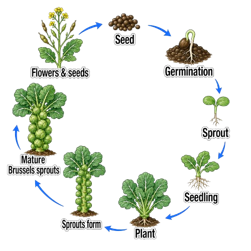
How Brussel Sprouts Grow
The Little Brussels Sprout’s Tall Journey
The Hardy Sprout
Once the seed awakens in the cool earth, a sturdy green shoot breaks through the soil. It unfurls its very first leaves, standing up tall to greet the fresh morning air and drink in the crisp sunshine (Ferragine, 2016).
Pushing Down Deep Roots
As the young plant settles in, it sends strong, webbed roots deep into the dirt. These roots act like anchors, keeping the plant perfectly steady while drinking up water and rich minerals from the soil (Ferragine, 2016).
Building the Green Tower
The plant doesn’t just grow out—it grows straight up! It builds a thick, woody central stalk that rises high above the ground, looking like a miniature green palm tree with large, waving leaves at the top (Ferragine, 2016).
Tiny Hidden Buds
Look closely along the tall stalk! Right where the large leaves join the stem, tiny green bumps begin to form. These little bumps are secret buds, getting ready to grow into something special (Ferragine, 2016).
Packing in the Micro-Nutrients
As the tiny buds drink up nutrients from the soil, they begin to pack themselves tight with health-protecting vitamins and fiber. These nutrients work hard to keep our digestion happy and our bodies full of long-lasting energy (Fuhrman, 2013).
Growing the Baby Cabbages
With plenty of cool autumn breezes, the tiny green buds swell and shape themselves into firm, compact spheres. They look exactly like adorable, baby-sized cabbages hugging the tall stem tightly (Ferragine, 2016).
The Bottom-to-Top Ripening
The little sprouts mature from the bottom of the stalk all the way to the top. As they grow plump and firm, they turn a beautiful, deep green color, full of immune-boosting antioxidants (Fuhrman, 2013).
The Tower Harvest
When the lower sprouts are firm, compact, and about the size of a large marble, they are ready! They are carefully snapped off the main stalk one by one, ready to be washed, cooked, and enjoyed as a crunchy superfood (Ferragine, 2016).
📚 Embedded Source Documentation
- Ferragine, Frank. Food to Grow. 1st ed., HarperCollins Publishers LTD, 2016, pp. 242-244. (Utilized for chronological data on central stalk elongation, axillary bud initiation along the stem, vertical maturation patterns, and optimal harvest dimensions).
- Fuhrman, Joel MD. Eat to Live Cookbook. HarperCollins Publishers, 2013, p. 159. (Utilized for mapping the compact budding phase to the synthesis of cruciferous micronutrients, dietary fiber profiles, and antioxidant values).
Hidtorical facts ;
Brussels sprouts are tiny cabbage-like buds that grow along a tall stalk. They belong to the same family as broccoli, cauliflower, kale, and cabbage. They became especially popular near Brussels, Belgium, during the 1500s, which is how they got their name. From there, they spread to other parts of Europe and later to gardens around the world