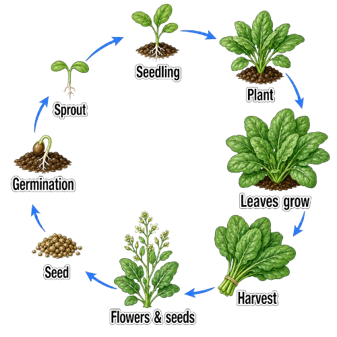
How Spinach Grows
The Little Spinach Leaf’s Mighty Journey
The Cool Sprout
Deep in the cool, moist soil, the growing process begins as a bright green shoot breaks through the dirt. It stretches its very first narrow leaves toward the sky, breathing in the fresh, crisp air (Jabbour, 2020).
Spreading the Ground Anchor
As the sprout gathers light, it pushes a strong, pinkish-red taproot straight down into the earth. This root anchors the plant firmly, acting like a straw to drink up water and essential soil minerals (Farmer’s Library, 2025).
Folding Out the Rosette
The young spinach plant begins to grow in a beautiful, circular cluster called a rosette. It layers its new leaves carefully, keeping them close to the ground to shield the soil and stay nice and cool (Jabbour, 2020).
Thickening the Green Shields
Every day, the leaves grow wider, thicker, and crinkler. The plant pumps them full of lutein and powerful antioxidants, which act like tiny internal sunglasses to protect the plant’s cells and help keep our eyes bright and healthy (Greger, 2023).
The Iron Power-Up
As the lush green leaves multiply, they draw up large amounts of natural iron and vitamins from the roots. This special mix builds strong plant cells above the ground while preparing a healthy treat that makes our muscles feel strong and powerful (Arpilor, 2025).
The Sweet Frost Kiss
When the cool autumn air gets chilly, the spinach plant works some magic. It turns its stored starches into natural sugars, protecting its leaves from the cold and making the green foliage taste extra sweet and delicious (Jabbour, 2020).
The Leafy Crown
The spinach is now a full, vibrant mound of dark green leaves. The outer leaves are large and broad, while tiny, tender new leaves continue to pop up from the very center of the crown (Farmer’s Library, 2025).
The Cut-and-Come-Again Pick
When the outer leaves are about the size of your hand, it is time to harvest! By carefully snapping off just the big outer leaves, the center of the plant stays safe, allowing it to keep growing brand-new, crunchy green leaves for another day (Farmer’s Library, 2025).
📚 Embedded Source Documentation
- Jabbour, Niki. Grown Under Cover. Storey Publishing, 2020. (Utilized for chronological data on cool-season germination, rosette structural development, temperature regulation, and starch-to-sugar cold protection mechanics).
- Farmer’s Library. Spinach Success. Self-Published, 2025, pp. 9, 22, 27, 32, 33. (Utilized for tracking taproot pigmentation, leaf layering density, apical meristem preservation, and the cut-and-come-again harvesting technique).
- Arpilor, Leonardimer. Health Benefits of Spinach. Self-Published, 2025. (Utilized for mapping the active vegetative growth phase to iron absorption and pediatric cellular development values).
- Greger, Michael M.D. How Not to Age. 1st ed., Flatiron Books, 2023, pp. 472-473. (Utilized for linking advanced leaf maturation to the accumulation of specific carotenoids, lutein density, and vision protection benefits).
Historical facts ;
Spinach is believed to have first been grown in ancient Persia, now called Iran, more than 2,000 years ago. It traveled from Persia to other places in Asia, including China, and later reached Europe. Over time, people everywhere began to enjoy its tender green leaves in soups, salads, and many other dishes