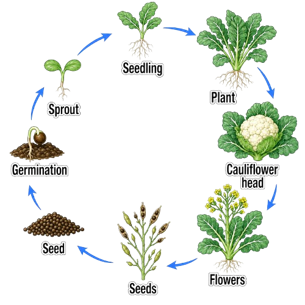
How Cauliflower Grows
The Little Cauliflower’s Big Journey
The Cool Sprout
Once the seed awakens in the cool earth, a sturdy little green shoot breaks through the soil. It unfurls its very first leaves, breathing in the fresh air and soaking up the crisp morning sunshine (Ferragine, 2016).
Spreading Large Protective Leaves
The young plant grows quickly, spreading out a wide circle of large, heavy green leaves. These big leaves stretch out like giant solar panels to gather energy, while strong roots anchor the plant deep in the dirt (Ferragine, 2016).
The Hidden Treasure
Right in the very center of the giant leaves, a tiny, secret prize begins to form. A small, creamy-white head called a “curd” appears, made up of thousands of tightly packed, un-opened flower buds (Ferragine, 2016).
Playing Hide-and-Seek
As the white head grows, the large outer leaves naturally wrap tightly over it like a blanket. This clever game of hide-and-seek shields the white curd from the hot sun, keeping it beautifully pale, crisp, and sweet (Ferragine, 2016).
Packing in the Protection
Underneath its green leafy blanket, the cauliflower head grows thicker and heavier. It pumps itself full of powerful, health-protecting nutrients and antioxidants that act like little shields to keep our bodies safe from getting sick (Fuhrman, 2013).
Growing the Super-Curd
The dense white dome continues to swell, staying compact and firm. The plant works hard to fill every single tiny white bud with healthy fiber and vitamins that keep our tummies happy and our immune systems strong (Fuhrman, 2013).
The Perfect Harvest
When the white head is big, firm, and smooth, but before the tiny buds start to separate or open up, it is ready! The main head is carefully cut from the base of the stalk, wrapped in its closest inner leaves to keep it safe (Ferragine, 2016).
Ready to Power Up!
Now, the crisp white cauliflower is chopped into bite-sized “trees.” Bursting with vitamins and immune-boosting power, this crunchy vegetable is ready to be cooked and enjoyed as a delicious super-food (Fuhrman, 2013).
📚 Embedded Source Documentation
- Ferragine, Frank. Food to Grow. 1st ed., HarperCollins Publishers LTD, 2016, pp. 242-244. (Utilized for chronological data on early vegetative leaf expansion, internal white curd initiation, natural leaf-blanching/shading behaviors, and strict pre-flowering maturity indicators).
- Fuhrman, Joel MD. Eat to Live Cookbook. HarperCollins Publishers, 2013, p. 159. (Utilized for mapping the dense curd development phase to the accumulation of cruciferous micronutrients, cellular health properties, fiber metrics, and pediatric immune-defense benefits).
Historical facts ;
Cauliflower is another member of the cabbage family. It grew from wild cabbage plants found around the Mediterranean region. Long ago, farmers selected plants whose flower buds formed large, soft heads called curds. Cauliflower was grown in the eastern Mediterranean and later spread through Europe and beyond.