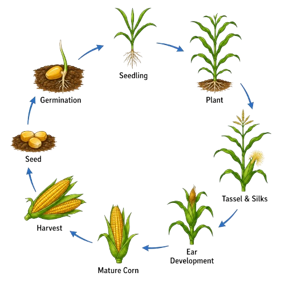
How corn grows
The Tall Corn Plant’s Big Journey
The Mighty Sprout
Once the seed awakens underground, a tight green spike pierces bravely through the soil. This little shoot uncurls its very first leaves, opening up like small flags to catch the bright morning sunshine (Westerfield & Eason, 2024).
Pushing Down Strong Roots
As the young sprout grows, it pushes strong anchor roots deep and wide into the earth. These roots hold the plant steady in the wind and act like straw pipelines, soaking up water and eye-healthy nutrients like lutein and zeaxanthin (Todd, 2015).
Reaching for the Clouds
The corn plant grows incredibly fast, shooting up toward the sky like a giant green tower. It develops a thick, sturdy stalk and wraps itself in long, waving ribbon-like leaves to gather all the sun’s energy (Westerfield & Eason, 2024).
The Tassel Crown
At the very top of the tall stalk, a feathery crown called a tassel begins to grow. This crown stands proud in the summer breeze, getting ready to shake down golden pollen to help the ears of corn form below (Westerfield & Eason, 2024).
Silky Green Surprises
Down along the middle of the stalk, little green packages wrapped in husks start to peek out. Out of the top of each package grows a bunch of soft, shiny hair called corn silk, which catches the pollen floating on the wind (Westerfield & Eason, 2024).
Growing the Kernels
Underneath the protective green husks, tiny kernels begin to form in neat rows. They drink up nutrients from the soil, packing themselves with healthy fiber and vitamins that give our bodies long-lasting energy (Todd, 2015).
Plumping Up the Ear
With plenty of sunshine, the ears of corn grow bigger, rounder, and firmer. The plant works hard to fill every single kernel with sweet, juicy goodness until the whole cob is full (Westerfield & Eason, 2024).
Ready to Pick!
When the silks at the top turn a deep, dark brown and the husks feel plump and tight, the corn is finally ready! With a quick twist and a snap, the sweet golden corn is harvested straight from the stalk to be enjoyed (Westerfield & Eason, 2024).
📚 Embedded Source Documentation
- Westerfield, Robert R., and Nathan Eason. “Growing Home Garden Sweet Corn.” University of Georgia Extension, 8 Aug. 2024. (Utilized for precise data on vegetative stalk development, wind-pollination tassel mechanics, silk formation, and optical harvesting metrics).
- Todd, Kaley. “Corn: An A-Maize-Ing Plant.” Environmental Nutrition, vol. 38, no. 8, Aug. 2015, p. 8. (Utilized for linking root absorption and kernel filling to specific health attributes, including carotenoids and dietary fiber).
Historical facts ;
Corn, also called maize, began as a wild grass called teosinte in Mexico about 9,000 to 10,000 years ago. Indigenous farmers carefully saved seeds from plants with bigger, better kernels. Over a very long time, the small wild grass changed into the tall corn plants with full ears that we grow today. Corn spread throughout the Americas and then around the world.